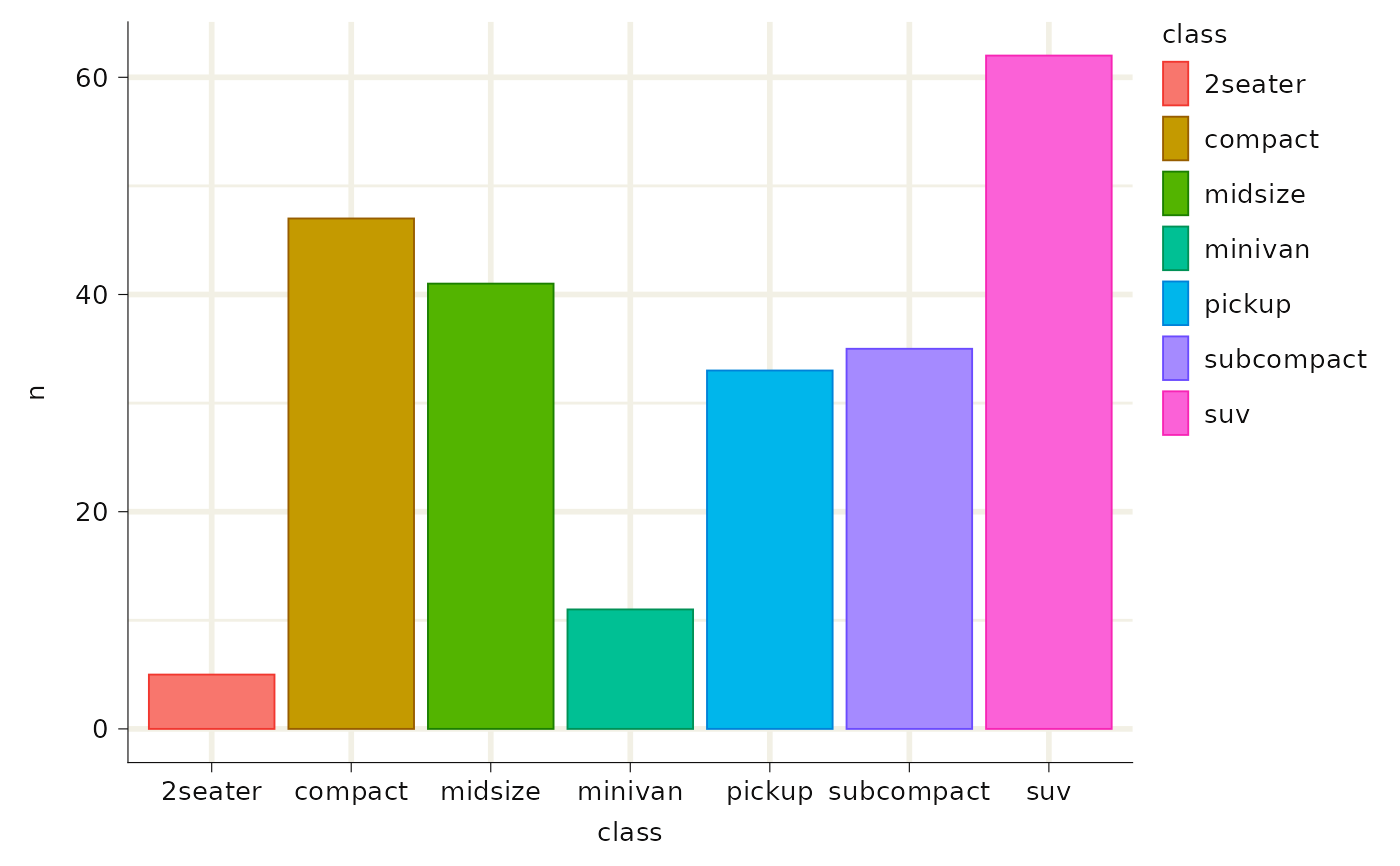
ggrefine() initializes a plot object using a specified plotting function
(defaults to ggplot2::ggplot()) and pre-populates default identity fill and
colour aesthetic mappings derived from the active theme's geom defaults
(falling back to "grey35" and "black" respectively).
These default aesthetics act as lightweight fallbacks and are cleanly overridden
when explicit mappings are added in subsequent layers via ggplot2::aes().
Usage
ggrefine(data = NULL, initialise = ggplot2::ggplot)Arguments
- data
Default data frame or graph object to use for plot. If not specified, must be supplied in individual layers.
- initialise
Function or lambda used to initialize the plot object (e.g., ggplot2::ggplot,
\(x) ggplot2::ggplot(x), or\(x) ggraph::ggraph(x, layout = "kk")). Defaults toggplot2::ggplot().
Examples
library(ggplot2)
library(dplyr)
#>
#> Attaching package: ‘dplyr’
#> The following objects are masked from ‘package:stats’:
#>
#>     filter, lag
#> The following objects are masked from ‘package:base’:
#>
#>     intersect, setdiff, setequal, union

set_theme(ggrefine::theme_lights())

mpg |>
  count(class) |>
  ggrefine() +
  aes(x = class, y = n, fill = class) +
  geom_col() +
  scale_colour_blend_discrete()